AI Deterrence Overview
Alarm.com AI Deterrence (AID) detects and automatically warns intruders, using artificial intelligence (AI) to observe the intruder and call them out in detail, sounding like a remote security guard. It turns your security cameras from passive recording devices into active deterrents that can scare away intruders.
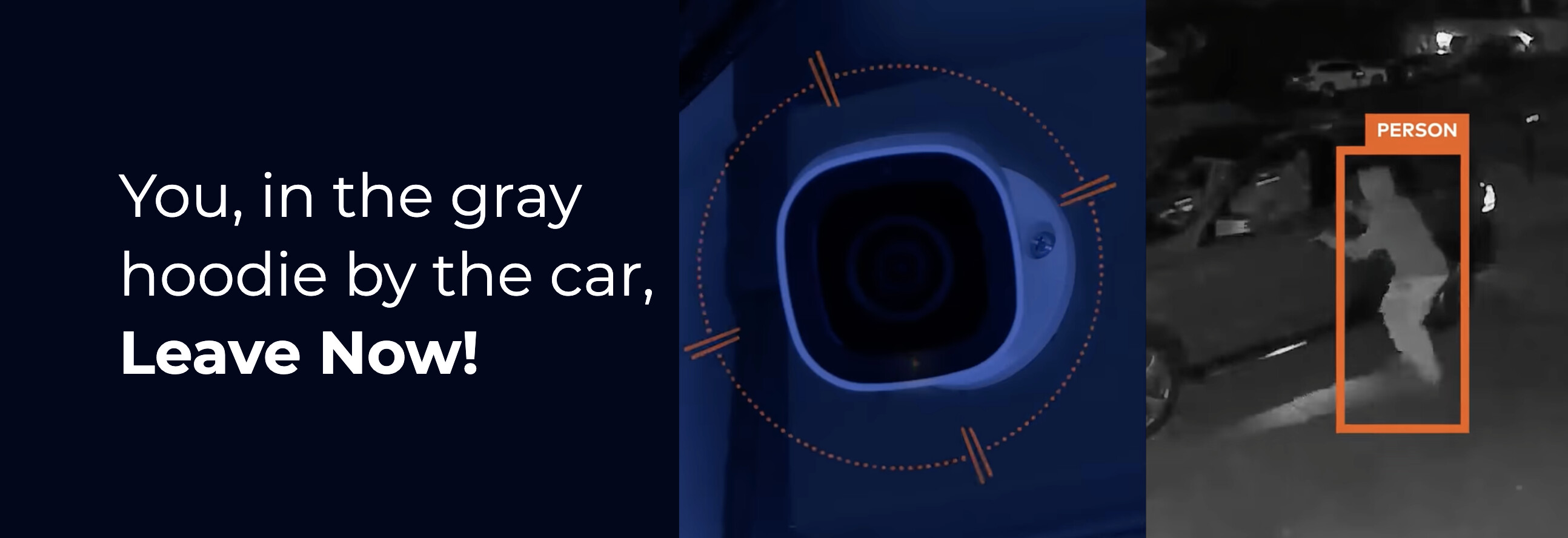
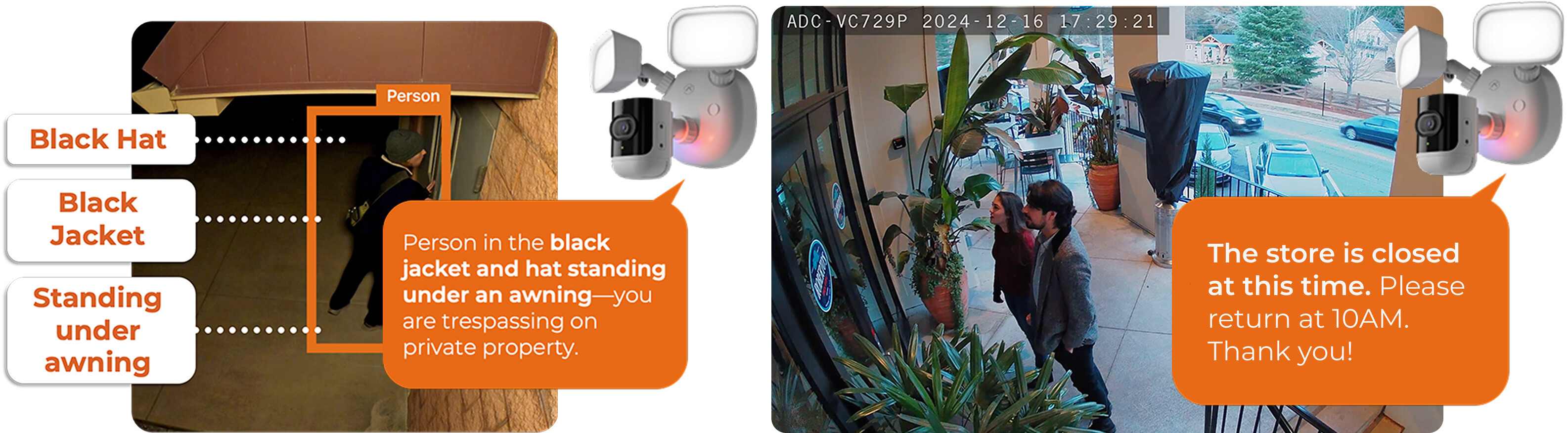
AI Deterrence uses video analytics to detect the intruder, and perimeter guard to warn the intruder, but AID takes it to a whole new level. Video of the intruder is analyzed by AI in real time to observe details about what they look like and where they’re located. The camera warns the intruder, calling out those details so that the intruder knows they’ve been caught and thinks they’re being talked to by a live remote guard, that threatens to send the police.
With Progressive Responses, AID can also escalate, starting with a calm warning and getting progressively more forceful if the intruder doesn’t leave.
How AI Deterrence Works
- AI Cameras Detect Intruder: Surety Alarm.com cameras use state-of-the-art artificial intelligence to detect an unexpected person or vehicle.
- AI Virtual Guard Observes: An AI-powered virtual security guard quickly observes the intruder to determine what they’re wearing and where they’re located.
- AI Virtual Guard Engages: The virtual security guard verbally warns the intruder, using their observed details to deliver a personalized message, sounding like a real live guard.
- AI Virtual Guard Escalates: If the intruder stays, the virtual guard can escalate through additional warnings, getting firmer each time and optionally adding the camera’s siren and lights. See Progressive Responses below.
While AI Deterrence may threaten to send the police, it won’t actually send the police. If you want to actually send the police, see Surety Cam Pro.
The AI virtual guard can be customized to use a variety of voices and to deliver different types of personalized messages to support various use cases. The final message is generated by AI but message type examples are:
- Deterrence: Please vacate immediately or the authorities will be called!
- Leave A Message: Unfortunately, I can’t get to the door right now but feel free to leave a message.
- Not Accepting Visitors: We’re not accepting visitors at this time. Please come back another time.
- Professionally Monitored: Please be aware that this property is professionally monitored and you are being recorded.
- Property Closed: This location is currently closed. Please be aware that this property is professionally monitored and you are being recorded.
- Trespassing: You are trespassing on private property. Leave immediately!
Progressive Responses
By default, an AID rule delivers a single response and stops. That’s called Single Response Mode. Progressive Response Mode instead lets you configure 2 or 3 escalating stages on the same recording rule, so the camera’s reaction gets stronger the longer someone loiters in your ground zone.
Each stage can start subtle, with a calm verbal warning and a gentle tone, and progressively intensify to stern warnings, sirens, and light alerts. Escalation is what makes the response believable. A warning that repeats itself in the same tone gets recognized as a recording, while a response that starts calm and hardens is how an actual person reacts to someone who won’t leave. It also means routine visitors, like a delivery driver at the wrong door, usually hear only the first stage and move on without setting off a siren.
The response style you configure for Stage 1 carries through the rest of the escalation, so you’re choosing how forcefully each stage is delivered, not writing three unrelated messages.
Stage Timing
Each stage has its own Duration inside area of interest setting, which is the time the person must keep loitering after the previous stage fired in order to trigger the next one.
| Stage | Loiter duration options |
|---|---|
| Stage 1 | 0.5 to 120 seconds |
| Stage 2 | 30 to 45 seconds |
| Stage 3 | 30 to 45 seconds |
Stage 1’s duration can’t be shorter than the Duration inside area of interest configured in the Record a Clip section of the rule. If you want Stage 1 to fire at the same moment the recording rule triggers, set both to the same value.
How Escalation Is Tracked
AID tracks each detected person in the ground zone on their own loiter timer, so one person lingering doesn’t escalate the response for everyone else in view. If an individual leaves the ground zone, their loiter state resets, and if they come back the sequence starts over at Stage 1.
Progressing past Stage 1 requires the camera to confidently observe continuous human presence in the ground zone. If the person steps partly outside the zone, becomes heavily obstructed, stands completely still for an extended period, or the scene shifts to low-contrast or infrared conditions, the camera may read that as the presence having ended and reset stage progression. Stage 1 still behaves exactly as configured in that case, and escalation restarts from Stage 1 once continuous presence is re-established.
Events, Clips, and Notifications
- A full escalation counts as one AID event against your monthly total, no matter how many stages fire. If the person leaves the ground zone and comes back, that re-entry counts as a new AID event.
- A clip is recorded for the Stage 1 response. Stage 2 and Stage 3 capture a snapshot at the moment the stage fires rather than a second clip.
- App push notifications are sent when the first stage triggers, not on each stage.
- Each stage that fires sends a separate monitoring station event. If you use Surety Cam Pro, that means the remote guards see the encounter escalating in real time and can intervene while it’s still in progress.
Progressive Response Mode is configured in your recording rule’s Perimeter Guard section, in place of the default Single Response Mode. It does not support Tripwire recording rules, so use a Ground Zone. For a walkthrough and discussion, see Progressive Responses for AI Deterrence.
AI Deterrence vs Surety Cam Pro
Surety Cam Pro uses Alarm.com Remote Video Monitoring (RVM) to enable live remote guard response when cameras detect intruders.
AI Deterrence is a compelling alternative to having cameras monitored by live remote guards because it costs less and responds faster. On the other hand, AID will not automatically dispatch police like a live remote guard can. Instead, when you receive the person-detection notification you can talk down to the intruder yourself through the camera’s two-way audio and, if you choose, call police yourself.
The two also work well together. With Cam Pro, a Progressive Response escalation reports each stage to the monitoring station as it happens, so the AI handles the immediate response while live guards follow the situation and can dispatch if it doesn’t resolve.
Using AI Deterrence With Surety
AI Deterrence is compatible with the following Alarm.com cameras:
- ADC-V515 with firmware 0.0.5.549+
- ADC-V516 with firmware 0.0.3.104+
- ADC-V523/523X with firmware 0.8.2.048+
- ADC-V530
- ADC-V724/724X with firmware 0.8.2.048+
- ADC-V730
- ADC-VC727P with firmware 0.8.2.048+
- ADC-V729/V729AC/VC729P with firmware 0.8.2.048+
- ADC-VDB775
Progressive Responses require a newer camera and are currently supported on the ADC-V516, ADC-V530, ADC-V730, and ADC-VDB775. The other cameras above still support standard AI Deterrence in Single Response Mode.
To use AI Deterrence with Surety, you need a video plan such as Surety Cam, Surety Protect, or Surety Complete. You also need the AI Deterrence add-on, which is available with those plans. Use System Manager to add the AI Deterrence add-on to your plan.
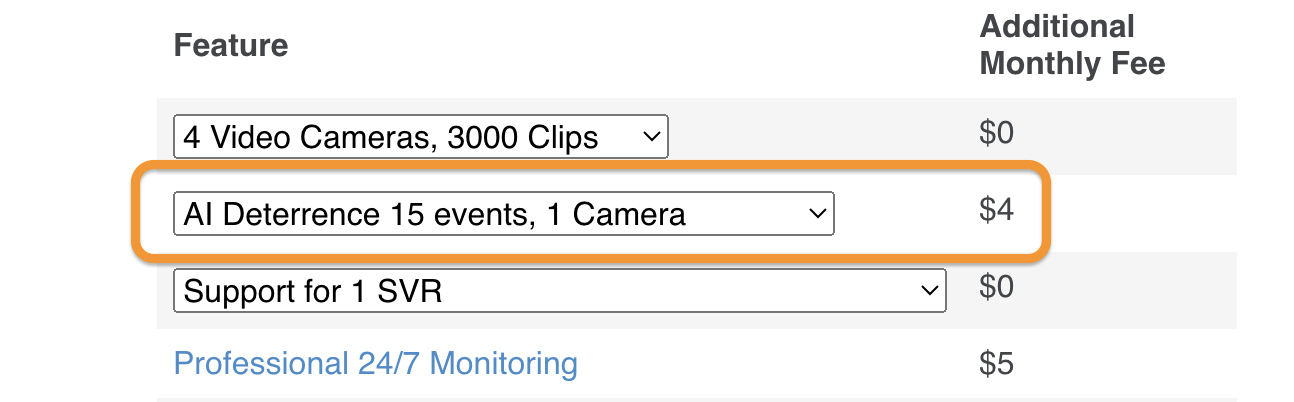
Each AI Deterrence add-on level enables 1 additional camera for AID and adds 30 AID events/month to your plan. For example, if you add 2 AI Deterrence levels to your plan then you can use 2 of your cameras for AI Deterrence and you have 60 AID events/month on your plan. Those 60 events can occur on any AID-enabled camera.
Progressive Responses don’t consume events any faster. An encounter that escalates through all of its stages still counts as a single AID event.
When you first enable AI Deterrence on your account you get extra AID events for free to use for setup and testing.
AI Deterrence Best Practices
Since your number of AID events each month is limited by how many AI Deterrence add-on levels you have, it’s important to only use AI Deterrence when & where you don’t expect anyone to be. Limit AI Deterrence rules to only cover places and times when no one should be there. For example, use AI Deterrence in your back yard only at night or when your alarm system is armed. Don’t use AI Deterrence on your sidewalk where neighbors may walk by.
If you want to use AI Deterrence to monitor an area that’s more active during the day but should have no activity at night then set up 2 separate recording rules on that camera, a daytime rule that records but doesn’t do AID, and a nighttime rule that does AID.
AI Deterrence analyzes video of the intruder to determine what they look like and where they’re located. In order to get the best results, we recommend setting your AID-enabled cameras to the maximum saved video resolution so that the AI has more video detail to work with.
Proper camera installation, calibration, and recording rule configuration are important to ensure your monthly AID events aren’t wasted.
Progressive Response Best Practices
Progressive Responses depend on the camera tracking one person continuously for the whole escalation, so scene quality matters even more than it does for standard AID.
- Keep the scene lit. Lighting that lets the camera stay in full color mode, instead of dropping to low-contrast or infrared modes, gives the AI the detail it needs to hold tracking through all the stages.
- Draw tight ground zones. Keep the zone around the area you actually care about and avoid including high-traffic background, which can interrupt tracking or trigger responses you don’t want.
- Protect the line of sight. If the ground zone is regularly blocked by passing vehicles or heavy foot traffic, escalation may never trigger. Position the camera so a person can’t easily end up hidden behind an object inside the zone.
- Expect reduced accuracy with crowds. Response accuracy and delivery degrade with groups larger than about 4 people.
- Use a Ground Zone, not a Tripwire. Progressive Response Mode doesn’t support Tripwire rules.