The way code works is that it doesn’t fix the past. It doesn’t prevent people from not following it either.
I’ve lived in the NE and all of those homes had condensate shutoff. This doesn’t mean I think you are not truthful. It just means our experience is different.
I think we both agree a simple condensate shutoff in the pump is a simple insurance option for the issue you just had. I actually have at least two sensors on each system. The pumps and the secondary catch pan. Where I don’t have a pump I have a switch on the condensate line before the trap.
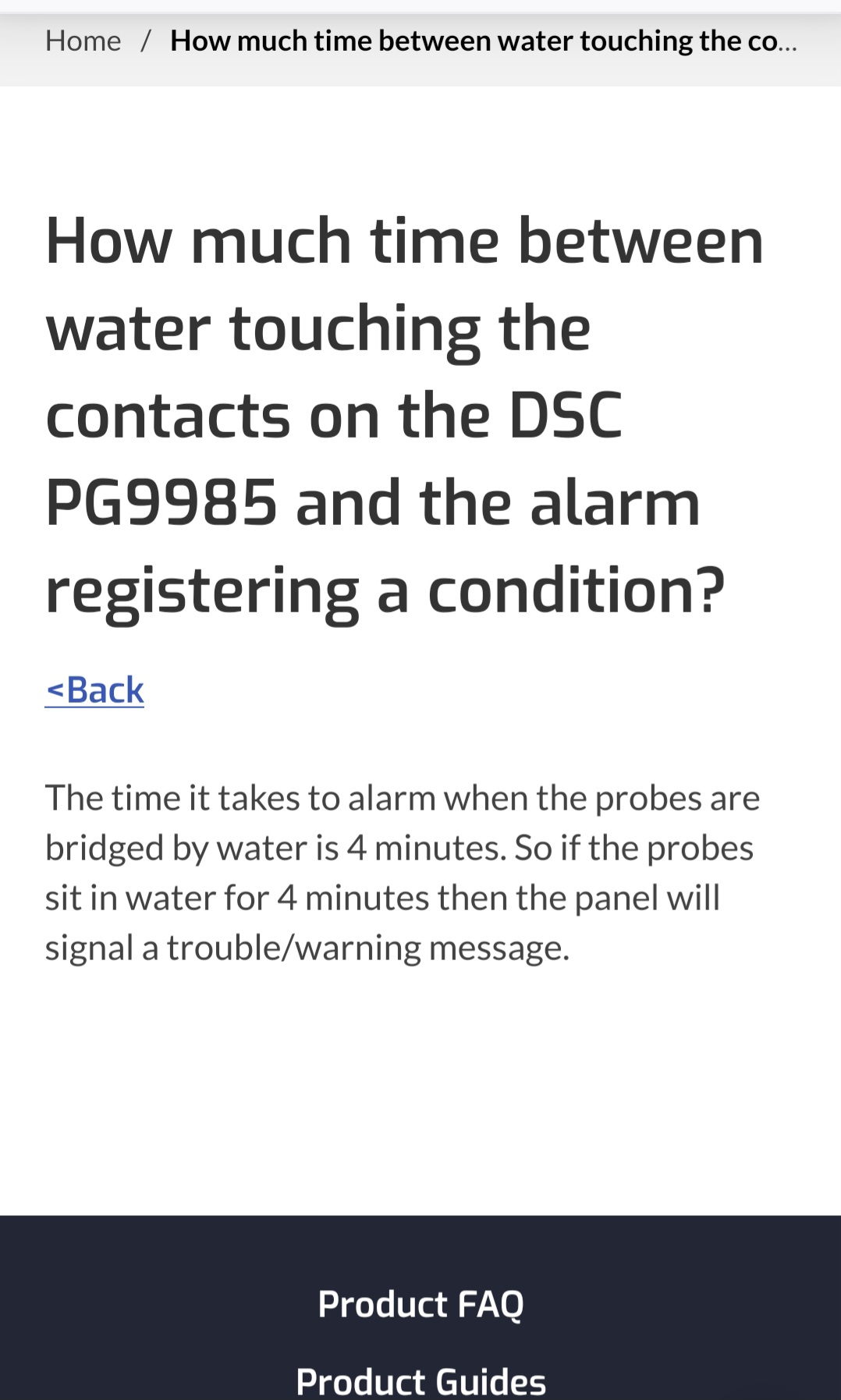
Yes, none of this has anything to do with your sensor. You have said it didn’t work in water. Does it work in tap water? You may need to wait more than 4 minutes.
Do you have some barkeepers friend cleaner? Usually used for stainless pans etc. Maybe you have something similar. You can try a little vinegar. Clean the sensor contacts and try again. I would also check the wiring.
Sensors aren’t guaranteed forever. Some failure rate is expected across all brands. I’ve had other brands silence pretty fast when the water was a quarter inch so the types with remote cables are good options.
I did a quick look but can’t find anything regarding local code on condensate shut-offs in NY (state, not city). Doesn’t mean it doesn’t exist, I just can’t find it. Also never seen one wired in my area and didn’t even know they existed until recently. I’d be very concerned if if was code in my area, since the various HVAC companies I have worked with were very careful to follow code. In two homes it was new construction and passed inspection. Other “resale” homes also passed inspection from insurance agents, bankers, and home inspection services. It would be concerning if none of these caught what should be an obvious violation.
Either way, I agree a shutoff is a good idea. I have en electrician coming today to see how we can wire the pump shut off to both the furnace and a dehumidifier. I’m comfortable with the furnace/thermostat wiring, but would rather not get into relays to disable the outlet. I might also explore some kind of shut-off through the alarm system… which might be an easier, but potentially less reliable, solution
Two of my three condensate pumps are now in pans. Third one will also have one when I can get to that house. That should buy me some time if all fails at once.
I’m also building a small “dam” of sorts around the furnace and water heater. This will act as an as hoc catch basin. Water can build up to almost 1/2” over a fairly large area before overflowing. The flood sensor then has more water and time to work with.
I haven’t done any further testing with the current sensor. It obviously failed. Knowing that failure is possible, even when it will still work by manually shorting the leads, answered by original question. Going forward, I will use multiple flood sensors connected to the panel and hopefully avoid the same problem in the future.
This doesn’t surprise me at all. I buy and renovate homes for rental income. I typically find things on a house that inspectors miss. Happened just the other day and was totally related. A friend was buying a 2.5M home so I said I would give him a free inspection. He was certain the guy that spent 6 hours in the house found everything. Within 5 minutes I pointed out the two 80gal water heaters were sitting in catch pans on platforms, but there was no drain line and the pans still had wide open holes in the side where you attach the drain line. Not only that like you there is no floor drain. So any water is going to flood 2800sqft of finished basement. So, buyer got a nice deduction from the price.
In NY the switches are required above living spaces. In your basement the secondary pan needs to have a drain. If the secondary catch pan does not have a drain…I assume your pan on the floor does not.. You can meet code with the switch. I do not know what year that may have come into effect. Been that way a while though.
I should mention I have a city appointmented role related to building and zoning code. So I’m maybe a little more aware of this space.
So does the sensor in question now work with tap water? I’m being specific with tap water because not all water conducts the same. Yes, any water should trip these sensors, but if we find a difference it hints at a problem. Your test of shorting the sensors with metal VS water indicates low battery, faulty wiring causing some resistance masking water conductivity or sensor pad sensitivity issues.
I’m about to buy maybe 12 of the new powerg+ water tiles. I’m just waiting for the cradles to become available.
If you don’t have whole house water Shutoff automation consider it while you are on the topic. You can often get some rebates on home insurance.
I did some testing with the old and a new PG9985. Results are disappointing, but at least I found the problem.
The PG9985 requires considerable depth of water to work. My flood was a relatively slow leak that “flowed” across the floor. Enough to make a splash when stepped in, but apparently not deep enough to activate the sensor.
This is confirmed through testing. I poured water on a granite counter top. Placed the sensor on the water and nothing. Both sensor pins were clearly in the water. Then I poured an inch of water into the sink and placed the sensor - that activated the alarm.
I’m not sure how much depth is needed for the sensor to work, but it is too much.
I also tested an ELK 319WA in the same exact conditions. It immediately activated on the counter top.
I was only able to get the PG9985 to work on the counter by placing a paper towel under the sensor pins. A product like this shouldn’t need a workaround.
This post really concerned me as I run a couple of these in places that wouldn’t accumulate a significant depth of water. Tested all of ours yesterday in real world conditions by spilling a few teaspoons of tap water on them and they all reliably alarmed.
I can’t imagine what the difference is, my first thought is the water, but if both condensate water and tap water are giving the same results, that is curious. Did both sensors come from the same source?
Two of the same PG9985 sensors. Both from different sources. One is a few years old. The other I just purchased.
No idea why, or if this is typical. Placed in pooled water on a granite countertop with both pins clearly in water. No alarm. Same exact conditions and the ELK immediately triggered an alarm.
It took more depth for the PG sensor to active an alarm condition.
All tests were with tap water.
My recent experience suggests that condensate water produces the same result with the PG unit. It has both pins touching water - roughly the same depth as my counter top test - but did not generate an alarm.
I’ve done all I can think of to solve the problem:
-Condensate pumps now have a cut off wired into the furnace and humidifier. If they fail, everything should shut off
-pumps are now in pans. PG sensors are inside those pans. That will guarantee enough depth to set off an alarm.
-I have built a silicone dam around the affected area. This is to allow for a hot water heater issue (and an extra backup to the furnace). The dam will trap enough water to create a depth of water for the alarm to be set off.
The only remaining item is the dehumidifier. I’d rather not rely on a z-wave solution. There is a PG outlet that can connect to the system, but it requires an IQ4 panel (I have a 2+). I will probably upgrade my panel and get the outlet which will then shut off the dehumidifier if a water alarm is set off.
I’ve done some testing on our end with a PG9985 that is less than a year old, and so far, I have not been able to reproduce the same results.
The PG9985 triggered an alarm within 10 seconds using 5-10mL of water. I tested on smooth concrete, quartz countertops, the plastic drain pan from a tankless water heater, a stainless steel table, and a wooden desk, but I was able to consistently trigger an alarm within 10 seconds of setting the probe down.
I have other PG9985s installed under sinks, and they’ve quickly triggered in the few times where water has unintentionally reached the sensor.
Are there any other factors with the tests you’ve done that I might be missing?
No idea why I am seeing these results or what else I can do. Place PG sensor in water on counter - nothing. Wait 30 seconds, still nothing.
Lift sensor, dry off, and place a screwdriver across the pins - alarm is triggered
ELK sensor in same spot on counter - alarm triggers within a few seconds.
Back to the PG - no alarm. Back to the ELK - alarm.
Then I placed a paper towel, folded once, on the counter and let it absorb the water. Placed PG sensor on paper towel - alarm triggers. Poured come water in the sink - PG triggered.
I don’t have a measurement of the amount of water used or depth, but the puddle was roughly six inches in diameter. Pins were clearly in the water.
I would question the test, except that the ELK had no problem under the same exact conditions. In my testing, the PG sensors needed more depth of water to trigger an alarm vs the ELK. For my particular situation, this difference in depth is enough to result in significant water damage.
Try waiting 4 plus minutes. The docs state there is built in logic to avoid false positives and that 4 minutes is the magic number if that logic is triggered.