While the general aiming instructions will start to generate solar power for the camera, it is possible to improve the amount of power the camera receives by optimizing solar panel placement throughout the year. The goal is to produce, on average, more power than the camera consumes, with the battery helping on cloudy days and during the winter.
Key takeaways
- 10 AM–3 PM are peak production times
- Calculate the best angle and tilt
- When configuring tilt, take seasonality irradiance into account
Tools needed
- Compass
- A way to measure angles (such as a phone app)
Solar intensity
On an average day, there will be 4–5 hours of peak charging time between 10 AM and 3 PM. Solar irradiance is at its maximum during this period, so plan the installation so that the solar panel gets the most sunlight during that time. Avoid spots that are only sunny in the morning or evening and shaded during early to mid-afternoon.
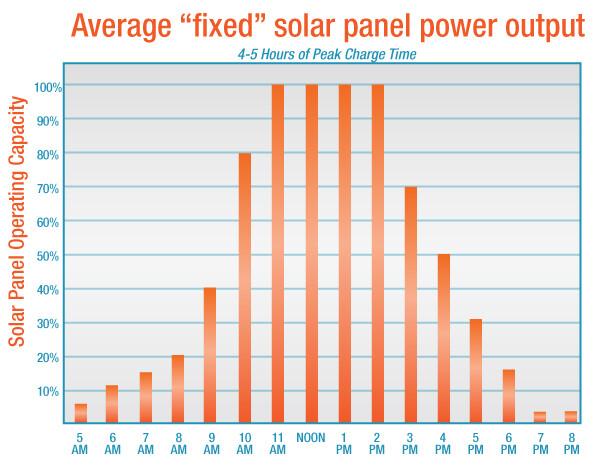
You can also monitor charging cycle times to see how long the camera is being charged each day to verify that the solar panel installation location is receiving adequate irradiance.
Aiming the solar panel
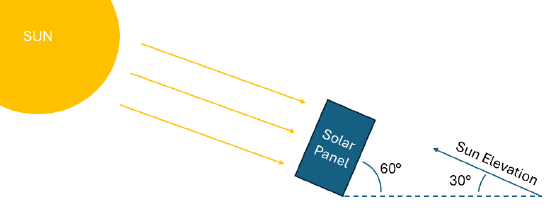
Beyond south-facing (or north-facing for the southern hemisphere) placement, the tilt of the panel strongly affects charging efficiency—especially in winter when days are shorter and the sun is lower. A starting rule of thumb is to aim the panel 180° south and tilt it to match your latitude. The angle between the lower edge of the panel and horizontal is calculated as 90° minus the sun’s elevation. For most U.S. users, this falls between 40° and 65°, with an average around 50°.
Accounting for seasonality
- Take local weather into account. Some areas are sunny year-round, others are not. In areas further from the equator, it may be necessary to install the solar panel at the more vertical end of the ±15° range to maximize wintertime solar efficiency.
- The battery in the ADC-V731B will not charge if the temperature is too high or too low. Position the solar panel to provide charging when the temperature returns to the safe range.
- Consider how shadows might move throughout the seasons. Objects that do not block the sun in summer could cause shadows in winter since the sun is lower on the horizon.
Example calculations
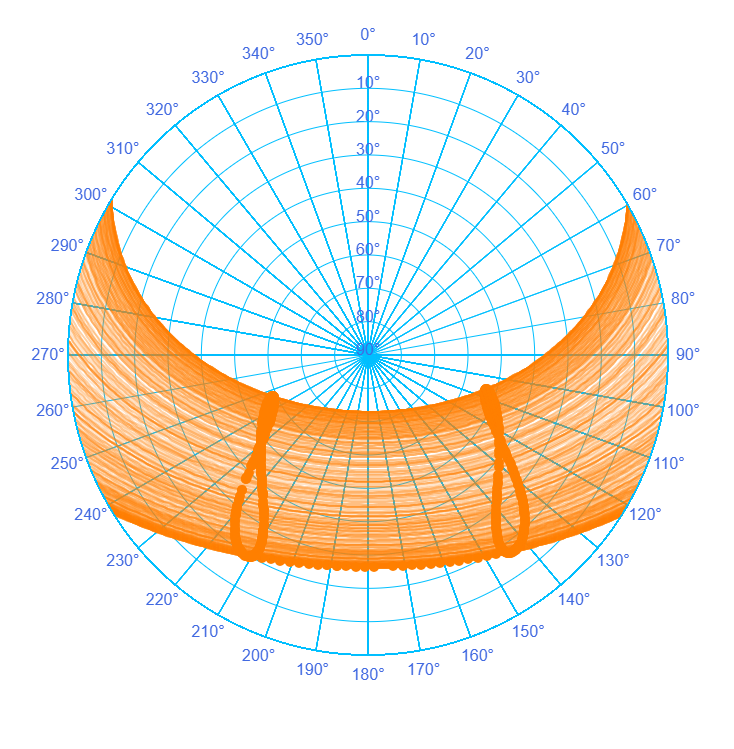
An example is shown below, calculated with help using the following website: https://www.pveducation.org/pvcdrom/properties-of-sunlight/sun-position-calculator.
This is a location with the sun’s path overlaid, with the dots marking the times 10 AM and 3 PM through the entire year:
Since only the peak times between 10 AM and 3 PM matter, the graph simplifies to this area:
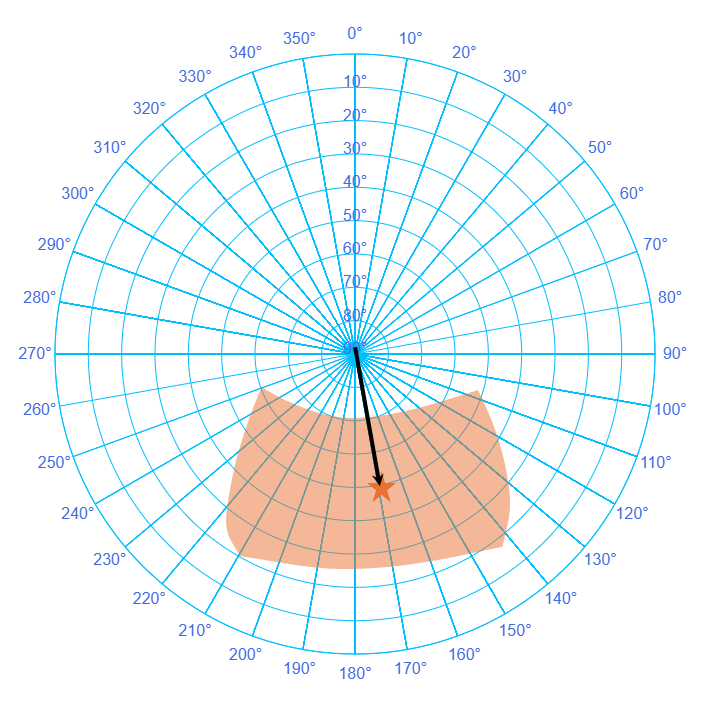
The black arrow indicates the direction to point the panel to aim for the middle of the sunny area through the year. The star shows the circular ring of the graph that corresponds to the angle of the sun to aim at. According to this graph, the ideal angle for peak sun would be 170° south facing and the angle of the sun would be at 50° up from the horizon, so the best tilt for a panel would be 40° (90°-50°) up from horizontal to best capture the sun through the sunniest hours of the day.
In most locations it is sunnier in the summer and often more cloudy in the fall, winter, and spring. It is recommended in most cases to aim the panel a littler more winter heavy to maximize solar irradiance during times when it might not be as sunny, In the previous example, while 170° south and 40° tilt is the average for all seasons, instead aim it with more bias toward the winter months (e.g., the bottom line in the circular graph) like 170° south and 50° or 55° tilt. Note that the angle did not change just the tilt to capture more low horizon sun.
Notice in this example where irradiance is calculated that the summer max irradiance is over four times the winter minimum.
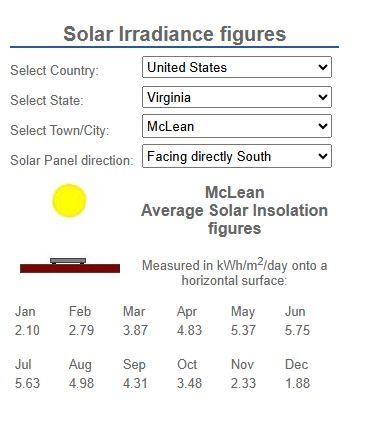
Aiming with wintertime in mind for a stationary mount might lose out on a little power in the summer, but it will also help capture more sunlight in the winter when it is harder to get. Also keep in mind that summer days are longer and so will get more sun exposure by default, even at reduced efficiencies.
Climates with extreme temperatures (hot and cold)
The battery of the ADC-V731B will only charge if the temperature of the battery is between 0°F and 113°F. To help account for that in the solar panel positioning, warmer climates should aim the panel to get more sun earlier in the summer days, and the colder climates should aim their panels to maximize charging later in the winter day. This helps to maximize the irradiance on the solar panel during the times of day that the battery would most likely be able to charge due to the temperature. For warmer climates, that means more sun in the summer mornings before it gets too hot in the mornings and early afternoon, and for colder climates trying to let the battery warm up with daily warming cycles and maximizing irradiance in the afternoons and early evenings.
More information on Alarm.com’s battery-powered camera ADC-V731B and the ADC-VACC-SP4W Solar Panel can be found here: